
Get Quote
Navigation
Free Consultation

© 2026 globalTaxAss.

GST Registration in Hyderabad
Registrations And Certificates

GST Registration in Hyderabad

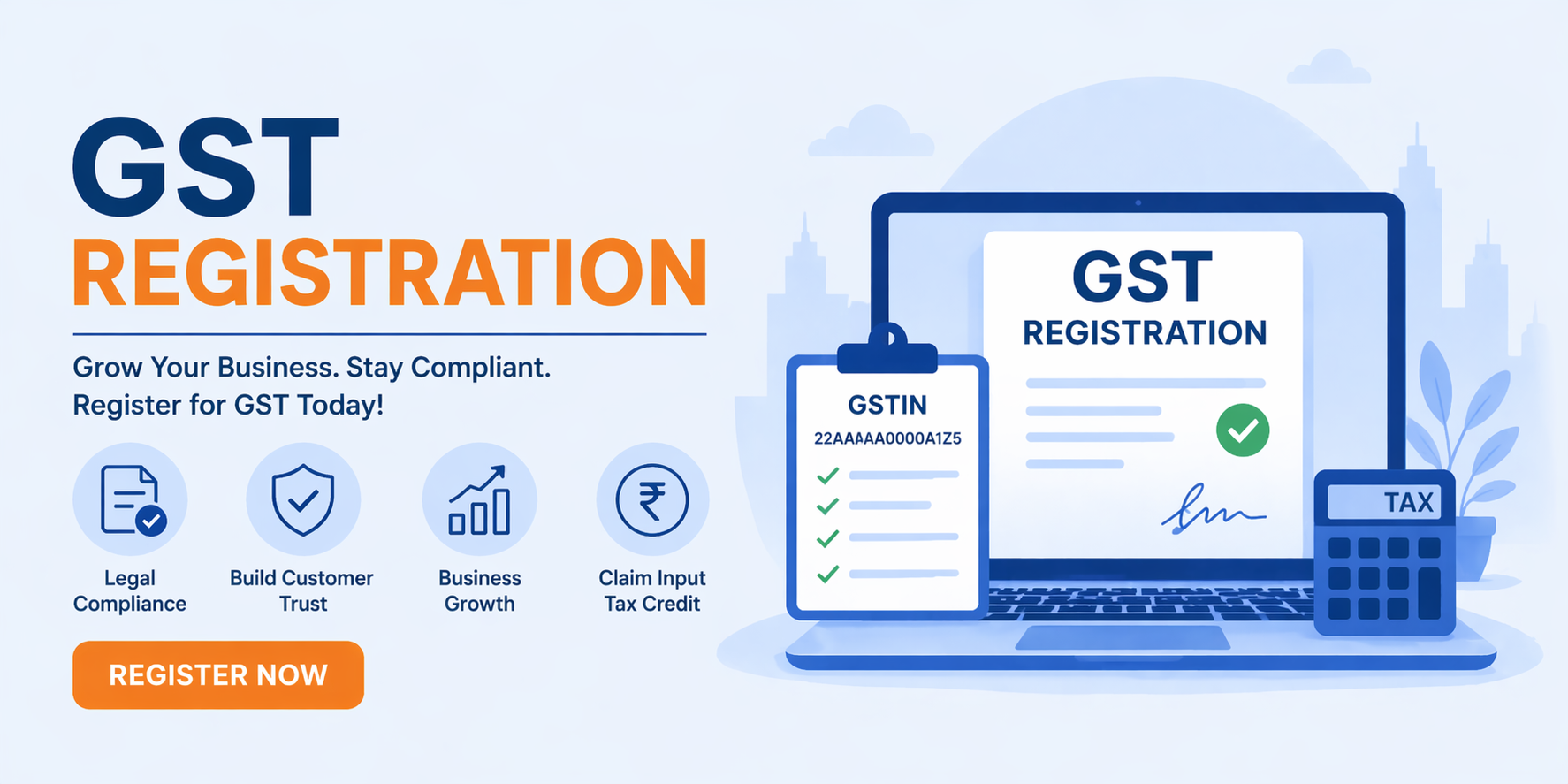
GST registration is the process by which a business becomes legally recognized under the Goods and Services Tax law in India. Once registered, a business is assigned a unique GSTIN (GST Identification Number), which allows it to collect GST from customers and claim Input Tax Credit (ITC) on business purchases.

24h Initial Audit
100% Compliance

Get a Custom Quote

Free 15-minute diagnostic call included.

Transparent Investment for GST Registration in Hyderabad

Premium fiscal management scaled to your global ambitions.

Complete GST portal registration and official certificate generation for a transparent price of

₹5,500 Save 27%
₹4,000

Fast and seamless GST registration to get your business legally compliant

  • 100% Accurate
  • Quick Setup
  • Govt Approved
Security & Compliance

Required Onboarding Documentation for
GST Registration in Hyderabad

To ensure absolute precision in your tax strategy and adhere to global KYC (Know Your Customer) standards, please prepare the following digital assets.

PAN Card of Business/Applicant

  • Income Tax Department

Aadhaar Card of Applicant

  • Unique Identification Authority of India

Business Address Proof (Electricity Bill / Rent Agreement / Property Tax Receipt)

  • Local Utility Provider / Property Owner / Municipal Authority

Bank Account Proof

  • Respective Bank

Detailed overview of GST Registration in Hyderabad

1. Eligibility: Who Must Register?

The requirement to register depends primarily on annual turnover and the nature of the business:

  • Service Providers: Registration is mandatory if annual aggregate turnover exceeds ₹20 Lakhs (₹10 Lakhs for special category states).
  • Goods Suppliers: Registration is mandatory if annual aggregate turnover exceeds ₹40 Lakhs (₹20 Lakhs for special category states).
  • Compulsory Registration (Regardless of Turnover):
    • Making any Inter-state taxable supply (selling from one state to another).
    • Selling goods through an E-commerce platform (like Amazon or Flipkart).
    • Casual Taxable Persons or Non-Resident Taxable Persons.
    • Businesses are liable to pay tax under the Reverse Charge Mechanism (RCM).

2. Choosing the Right Scheme

When registering, a business must choose between two primary schemes:

  • Regular Scheme:
    • Can collect GST from customers and issue tax invoices.
    • Eligible to claim Input Tax Credit (ITC) on all business-related purchases.
    • Requires filing monthly or quarterly returns (GSTR-1 and GSTR-3B).
  • Composition Scheme:
    • Designed for small businesses with turnover up to ₹1.5 Crores (₹75 Lakhs for special states).
    • Lower tax rates (1% for traders/manufacturers, 6% for service providers).
    • Cannot collect GST from customers and cannot claim Input Tax Credit.
    • Simplified compliance with quarterly payment and annual returns.

3. The Registration Process

The entire process is managed online through the GST Common Portal (www.gst.gov.in).

  1. TRN Generation: Fill out Part-A of the registration form using a PAN, mobile number, and email to receive a Temporary Reference Number (TRN).
  2. Application Submission: Use the TRN to log in and complete Part-B, providing business details, partner/director information, and proof of address.
  3. Verification: The application is digitally signed (using DSC or Aadhaar-based OTP).
  4. ARN Generation: An Application Reference Number (ARN) is generated for tracking.
  5. Approval: A GST officer reviews the application. If everything is in order, the GST Certificate and GSTIN are issued within 3 to 7 working days.

4. Post-Registration Compliance

Once the GSTIN is active, the business must:

  • Display the GST registration certificate at the principal place of business.
  • Mention GSTIN on all bills and signage.
  • File timely returns even if there is “Nil” business activity during a period.

Strategic Benefits

Tax Optimization

Legally minimize liabilities through intelligent treaty use.

Global Scalability

Standardize your compliance across 40+ countries.

Registrations And Certificates

Frequently Asked Questions on GST Registration in Hyderabad

Expert answers to your business and personal compliance queries.

It is mandatory if your annual turnover exceeds ₹40 Lakhs for the sale of goods, or ₹20 Lakhs for providing services. However, if you sell goods across state borders (inter-state), sell through e-commerce platforms (like Amazon, Flipkart, or Swiggy), or export services outside India, GST registration is mandatory from day one, regardless of your turnover.
Yes, voluntary registration is highly recommended for growing businesses. Having a GSTIN instantly boosts your brand's credibility. More importantly, it allows you to claim Input Tax Credit (ITC)—meaning you can get refunds on the GST you pay for your own business purchases. It also allows you to work with larger corporate B2B clients who only deal with GST-registered vendors.
Once our team submits your application with perfectly aligned documents, the government portal typically issues your unique 15-digit GSTIN (Goods and Services Tax Identification Number) within 3 to 7 working days. We track the Application Reference Number (ARN) daily to ensure there are no delays from the tax officer.
Once registered, you must begin issuing GST-compliant tax invoices to your customers and collecting the applicable tax. Crucially, you are now legally required to file periodic GST Returns (like GSTR-1 and GSTR-3B) every month or quarter—even if your sales are zero for that period. Our firm offers a monthly retainer service to handle all your GST filings, ensuring you never face late fees or portal blocks.
Basic documents include PAN card, Aadhaar card, business address proof, bank account details, and passport-size photographs of the applicant.

Still confused about compliance?

Our legal advisors are available for a 15-minute free discovery call.

Get Free Consultation
Connect on WhatsApp